
Why Arrival Temperature Is Not Enough: The Hidden Blind Spot in Cold Chain Shipping
The short answer
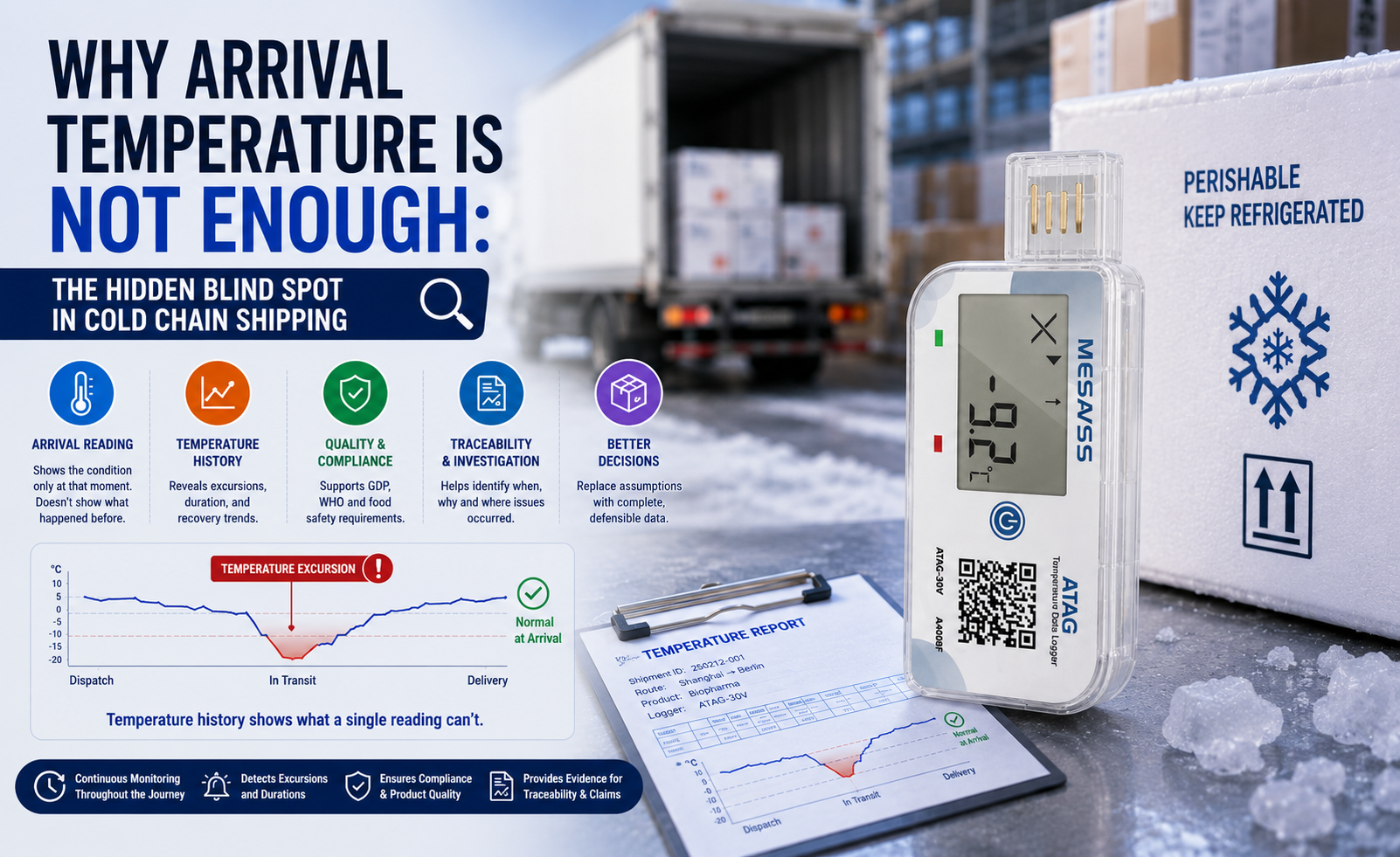
A temperature reading at destination only tells you the condition at that moment. It cannot show whether the shipment experienced a temperature excursion two hours, six hours or a day earlier. For temperature-sensitive products, the history between dispatch and receipt is often the part that matters most.
The problem with a 'good' arrival reading
A shipment can reach the receiving dock at an acceptable temperature after the cooling system has already recovered from an earlier disturbance. If the only checks are made at departure and arrival, the period in between becomes a blind spot. This is why continuous monitoring is used across many cold-chain workflows: it creates a time-stamped record of what the shipment actually experienced.
Temperature history is more useful than a single number
A complete record can answer questions that a handheld reading cannot: When did the temperature start to move? How long did it remain outside the expected range? Did the temperature recover gradually or suddenly? Was the event associated with loading, a stop, a door opening or a long route segment? These details are useful for quality review because the significance of an excursion depends on the product, the temperature reached and the duration of exposure.
Why this matters in pharmaceutical distribution
EU Good Distribution Practice guidance states that temperature monitoring equipment used during transport should be maintained and calibrated, and that customers should be provided with data demonstrating that products remained within the required transport conditions when requested. WHO guidance for time- and temperature-sensitive pharmaceutical products also treats transport monitoring as part of the control system, not as a final receiving check.
Food and fresh produce have the same visibility problem
The exact acceptance limits differ by commodity, but the operational principle is similar. FDA guidance identifies improper refrigeration or temperature control as a transport risk for food. FAO also emphasizes continuous cooling, rapid loading and pre-cooling for refrigerated transport. A single arrival reading cannot reconstruct whether those controls were maintained throughout the journey.
Where data loggers fit
For shipments where intervention during transit is not required, a standalone logger such as a single-use USB or reusable data logger can provide a continuous record for review at destination. The goal is not to create more data for its own sake. The goal is to replace assumptions with a defensible temperature history.
What to ask before choosing a monitoring method
Start with the quality question, not the device: What temperature range is required? How long is the shipment? Does the receiver need a PDF report immediately? Is an alarm summary enough, or is a full curve required? Does the shipment need real-time intervention, or only complete evidence after arrival? Once those questions are clear, the monitoring architecture becomes much easier to choose.
Takeaway
A normal temperature at arrival is useful, but it is not proof of an uninterrupted cold chain. The stronger evidence is the temperature history that connects dispatch, transit and delivery.