
Looking for a Sensitech Dry Ice Logger Alternative? 7 Things to Compare
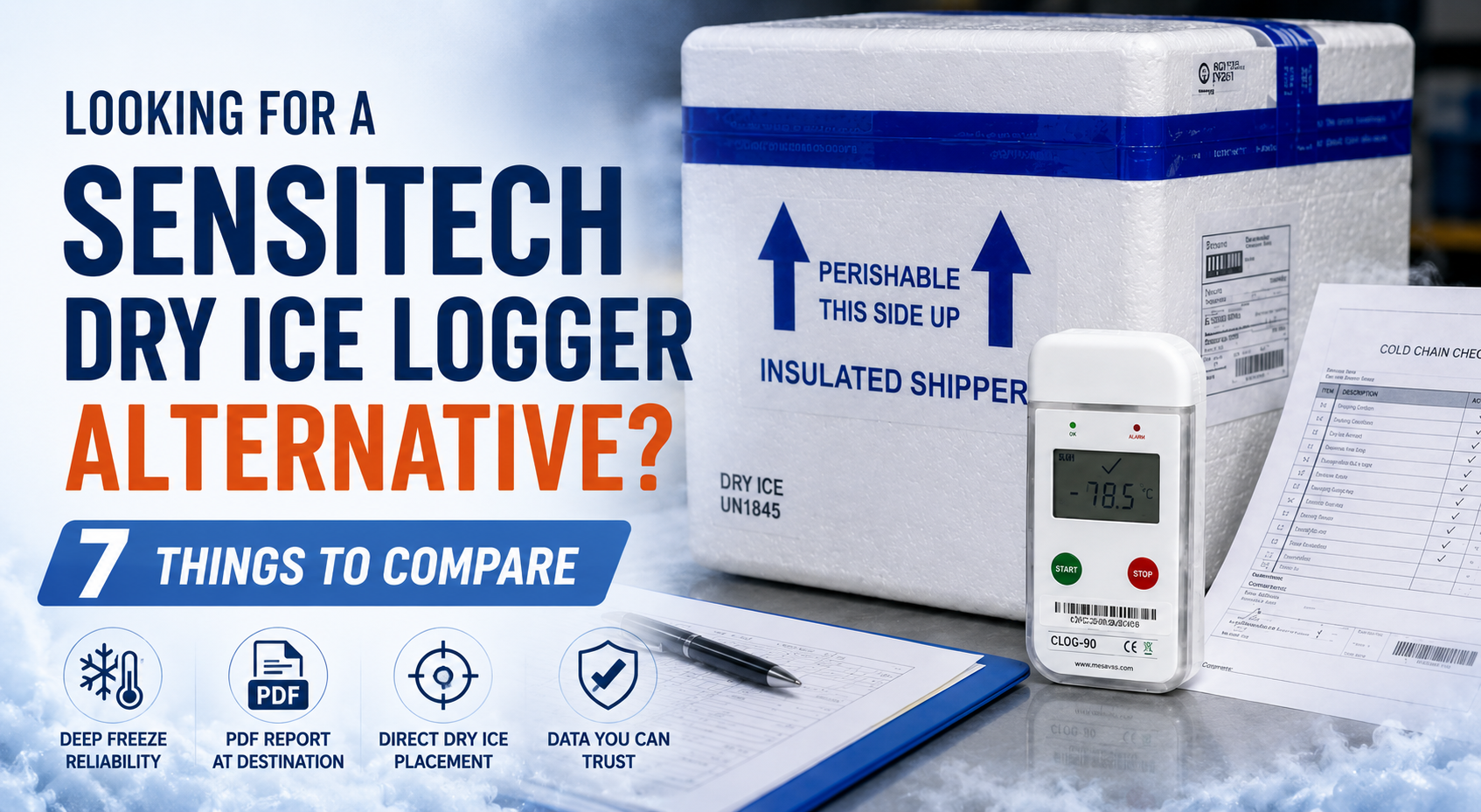
Searching for a “Sensitech alternative” usually means one of several things.
Sometimes the procurement team wants a second source. Sometimes a new lane needs a different workflow. Sometimes the current device works well, but the cost or lead time no longer fits the program. And sometimes the shipment has changed — for example, from conventional frozen transport to direct dry ice exposure — and the old monitoring setup is no longer the best match.
Whatever the reason, replacing a temperature logger should never start with a price list. Start with the seven things that determine whether the new device will actually work in your cold chain.
1. Compare the real low-temperature specification
Sensitech's TempTale Ultra Probeless Dry Ice is built for direct placement in dry ice environments and Sensitech states that it can be exposed to temperatures as low as -95°C. The linked datasheet also distinguishes operating range from measurement range.
That distinction is important. Ask every supplier for the exact measurement range, operating range and any duration limitations at the coldest temperatures.
CLOG-90 is specified by MESAVSS down to -95°C. That makes it relevant to the same general probeless dry ice use case, but qualification should still confirm performance for your specific trip duration and pack-out.
2. Decide whether you want probeless or external-probe monitoring
This is more important than brand.
A probeless logger sits inside the dry ice package. An external-probe system leaves the logger body outside the harshest environment while the probe measures the cold zone.
Sensitech offers both architectures. That alone is a clue that neither is universally better.
If you want a simple one-way pack-out with the complete logger next to the payload, a probeless design can reduce cabling and handling. If the logger needs to remain accessible during the trip, an external probe may be the better engineering choice.
3. Compare accuracy where it matters
A broad “±0.5°C” statement is not enough for ultra-low-temperature work unless it applies to the part of the range you actually use.
Accuracy often changes across temperature bands. Ask for the accuracy at -80°C and below, not only at room temperature. If your quality decision depends on distinguishing -82°C from -88°C, the low-end accuracy specification deserves more attention than the marketing headline.
4. Map the alarm logic to your stability rules
Sensitech documents multiple programmable alarm options for its TempTale Ultra Probeless Dry Ice model. That can be useful when release decisions depend on duration, cumulative exposure or several temperature bands.
An alternative logger should be checked against the same SOP. Can it reproduce the alarm logic your team actually uses? Can the receiver see the alarm status immediately? Is the alarm result clearly documented in the report?
A cheaper logger that forces the quality team to change the decision rule is not automatically a cheaper solution.
5. Check how the report is generated and protected
At destination, the fastest route to confusion is a logger that requires software the receiver does not have.
Sensitech can generate secure PDFs and encrypted data files and also connect to its own data management software. CLOG-90 generates an encrypted PDF through USB without a dedicated reader.
Neither workflow is automatically better. A multinational pharma organization may prefer centralized software and validated archiving. A clinical-sample lane between two sites may value a self-contained PDF that can be opened immediately.
Choose the data workflow that fits the receiving reality.
6. Compare calibration, validation and transport documentation
This is the area where “alternative” claims most often become misleading.
Sensitech has a mature validation and calibration framework around TempTale products. If your SOP references a specific certificate format, software validation package or transport approval, changing the logger can trigger additional qualification work.
Before approving another device, ask for the complete documentation set and compare it line by line with your user requirements. Do not assume that two loggers with the same temperature range carry the same compliance evidence.
7. Compare total deployment cost, not only unit price
Unit cost is visible. Process cost is not.
Add the time needed for configuration, training, receipt, downloading, QA review, archiving, software licenses, returns, technical support and supplier qualification. Then consider supply security: do you want a second approved source in case the primary supplier has a lead-time problem?
For some companies, staying with Sensitech is the lowest-risk decision. For others, qualifying another product creates useful sourcing flexibility.
MESAVSS CLOG-90 is one probeless option that can be evaluated when a team needs direct dry ice placement, local status on the device and USB PDF reporting down to a specified -95°C lower limit.
A better way to think about alternatives
The goal is not to find a device that looks similar. It is to find a monitoring workflow that produces evidence your quality team can trust.
If the replacement changes placement, alarm logic, accuracy, reporting or validation, treat it as a new monitoring system and qualify it properly. If those elements line up with your requirements, an alternative supplier can reduce sourcing risk without weakening cold-chain control.
FAQ
What is a good alternative to Sensitech for dry ice monitoring?
There is no universal answer. CLOG-90 is one option for a probeless, single-use dry ice workflow, but buyers should compare range, accuracy, alarms, calibration, reports and validation requirements before qualification.
Should I choose probeless or external probe?
Choose based on pack-out and access. Probeless loggers simplify direct placement; external probes keep the logger body accessible outside the coldest zone.
Is price the main reason to qualify a second logger?
No. Supplier continuity, lead time, workflow fit, special temperature ranges and data requirements can be equally important.
What is the biggest switching risk?
Assuming hardware similarity means workflow equivalence. The real differences often appear in calibration evidence, alarm logic, software, data integrity and SOP integration.