
Best Probeless Dry Ice Temperature Logger: 7 Things That Actually Matter
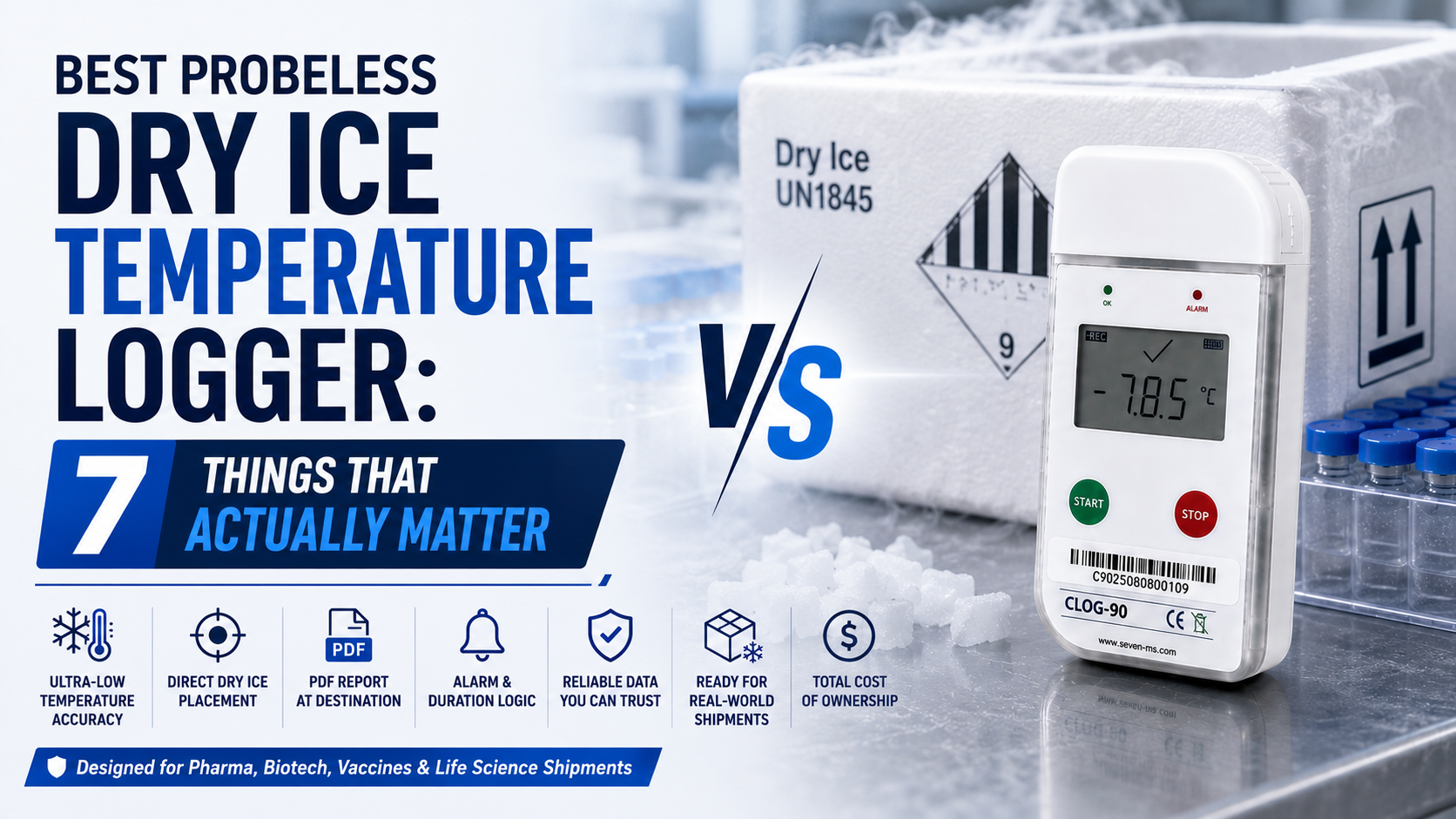
There is no single “best” dry ice temperature logger for every shipment.
A logger that works perfectly for a two-day clinical sample shipment may be a poor choice for a 20-day international lane. A device that fits a standalone PDF workflow may be wrong for a company that needs every trip record inside a validated enterprise database.
So instead of starting with brand names, start with the seven things that determine whether a probeless logger will work in the real shipment.
1. The real low-temperature range
Dry ice is often described as a -78.5°C environment. That does not mean every point inside a dry ice shipper stays neatly at that temperature.
Published dry ice logger specifications from major manufacturers extend to -90°C or -95°C because actual conditions can go colder than a simple “-80°C shipment” label suggests.
If the logger bottoms out during the trip, the record may show a flat lower limit rather than the real temperature. For high-value biologics or samples, that is not the kind of ambiguity QA wants.
Start by reviewing packaging qualification data. Choose a logger whose range covers the coldest credible condition with margin.
2. Accuracy where the shipment actually operates
A temperature logger can have one accuracy value near room temperature and a different value below -80°C.
That is normal physics and electronics, but it means the buyer should not stop at a headline accuracy statement.
Ask for the accuracy band around your actual operating temperature. If your stability or handling decision depends on a narrow boundary, low-temperature accuracy should be part of the user requirement specification.
3. Runtime at ultra-low temperature
Battery performance is one of the least glamorous and most important parts of a dry ice logger.
ELPRO's LIBERO CD documentation, for example, gives different service-life guidance depending on how deeply and how long the unit is exposed to ultra-low temperature. Sensitech also publishes continuous-exposure guidance for its probeless dry ice device.
That tells buyers something useful: “can measure to -95°C” is not the same question as “can operate for my entire lane at -95°C.”
Match runtime to the worst credible transit duration, including delays.
4. Placement and pack-out simplicity
A probeless logger removes the external cable, but it does not remove the need for a placement rule.
Decide where the logger should sit relative to the payload and dry ice. Make that location repeatable. If the placement changes from shipment to shipment, comparing curves later becomes harder.
Probeless designs are particularly attractive for one-way shipments because pack-out is simple and the logger can remain with the cargo until receipt.
5. Alarm logic that matches the product
A logger's alarm should translate product stability rules into something the receiving team can use.
For one product, a short excursion may be acceptable. For another, cumulative time matters. Some workflows need multiple high and low bands.
Do not pay for alarm complexity you do not use, but do not choose a device that cannot reproduce the decision logic required by QA.
6. Report integrity and usability
At destination, data has to become evidence.
A useful report should clearly identify the device, trip timing, temperature curve, min/max values, alarm result and configuration. It should be easy for the receiver to open and difficult to alter without detection.
USB PDF loggers are popular because they can create a portable trip record without a special reader. Some suppliers go further with encrypted raw files, PDF/A or centralized cloud/database workflows.
Choose the level of data control that fits your quality system.
7. Calibration and qualification evidence
For life sciences, a good logger is not only hardware. It comes with evidence.
Ask for calibration traceability, accuracy documentation, product specifications, transport safety records and any relevant standards. If the device includes software, consider how that software is controlled and validated.
Then run a pilot. Put the logger into your actual packaging, on your actual lane, with your actual receiving process. Qualification data from your own workflow is more useful than a generic “best logger” ranking.
Where MESAVSS CLOG-90 fits
CLOG-90 is a single-use, probeless USB logger designed for direct placement in dry ice and other ultra-low-temperature shipments. MESAVSS specifies it down to -95°C. The device includes an LCD for quick status review and generates an encrypted PDF report through USB at destination.
That combination makes it relevant for one-way pharmaceutical, biological and clinical-sample shipments where the team wants local recording and straightforward post-trip evidence without relying on a cellular network.
What actually matters
The best probeless dry ice logger is the one that covers the coldest credible temperature, lasts for the whole trip, matches the product's alarm rules and produces evidence your quality team can trust.
Brand reputation matters. Price matters. But neither should come before the actual user requirements.
If you get those requirements right, the shortlist usually becomes much smaller — and much easier to defend during qualification.
FAQ
What temperature range should a dry ice logger cover?
Use packaging qualification data to define the coldest credible condition. Many direct dry ice loggers extend below -80°C, with some designed to -90°C or -95°C.
Is probeless always better than an external probe?
No. Probeless is simpler for direct placement and one-way shipments; external probes can be better when the logger body must remain accessible or sensor placement needs more flexibility.
Why does runtime change at ultra-low temperature?
Battery chemistry and electronics are stressed by very low temperatures. Always check service-life guidance at the actual exposure level.
What makes a report useful for QA?
Clear device identification, trip timing, full temperature history, alarm logic/results, statistics, configuration information and appropriate data integrity controls.