
Five Cold Chain Blind Spots That Create Temperature Risk During Transport
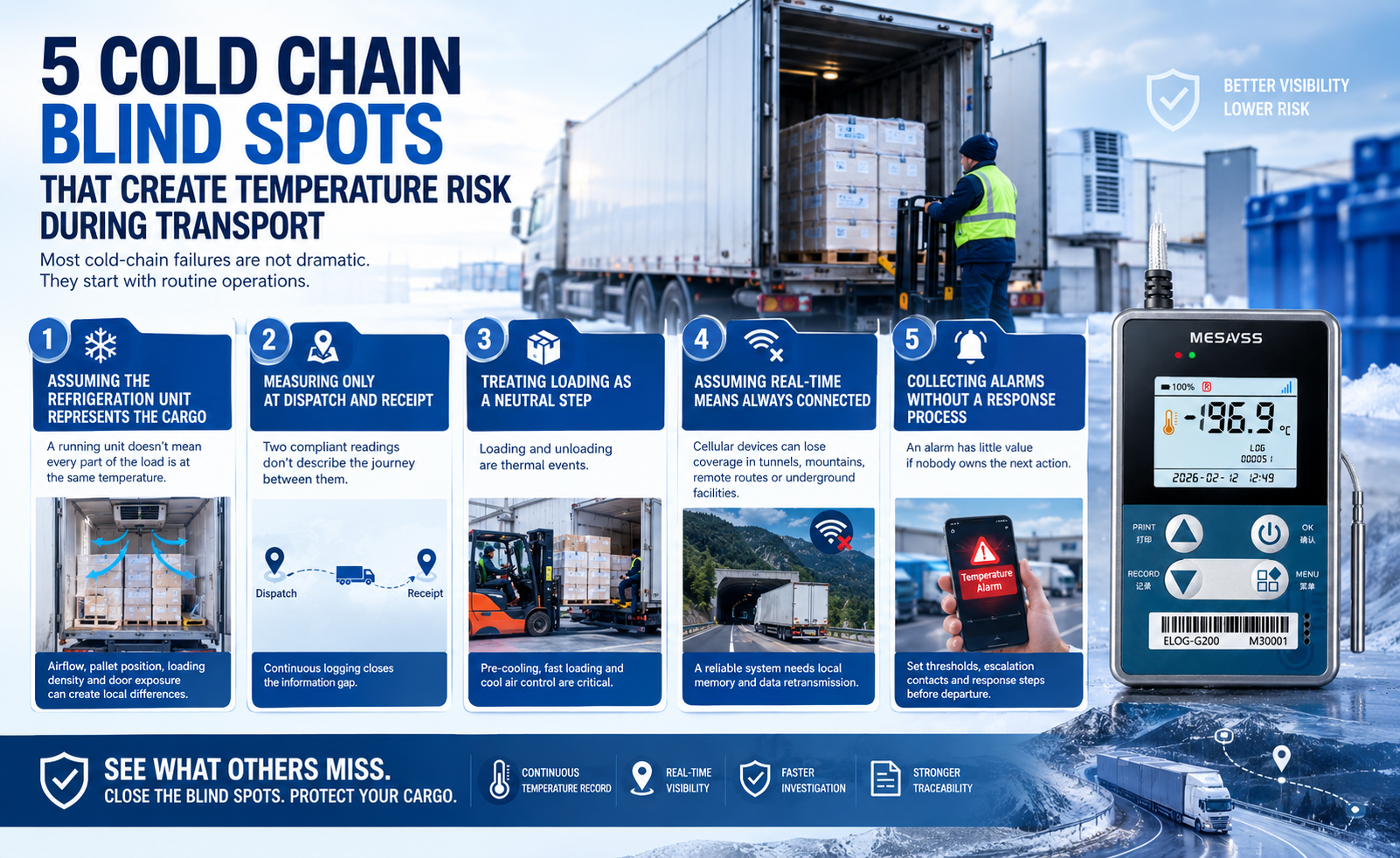
Most cold-chain failures are not dramatic
The biggest transport risks are often ordinary: loading takes longer than planned, a door stays open, a vehicle is not fully pre-cooled, a route passes through poor network coverage, or temperature is only checked at the beginning and end. None of these looks catastrophic in isolation. Together, they create blind spots.
Blind spot 1: assuming the refrigeration unit represents the cargo
A running refrigeration unit does not prove every part of the load is at the same temperature. Airflow, pallet position, blocked returns, loading density and door exposure can create local differences. Vehicle status and cargo temperature are related, but they are not the same measurement.
Blind spot 2: measuring only at dispatch and receipt
Two compliant readings do not describe the journey between them. This 'end-point only' approach can miss temporary excursions and makes investigations difficult. Continuous logging closes that information gap.
Blind spot 3: treating loading as a neutral step
Loading and unloading are thermal events. A pre-cooled product can be exposed to warmer ambient air, while a warm vehicle or slow loading process can add heat before the route even begins. FAO guidance for refrigerated transport specifically emphasizes pre-cooling and fast loading under temperature-controlled conditions where possible.
Blind spot 4: assuming real-time means always connected
Cellular devices can temporarily lose coverage in tunnels, mountainous areas, remote routes or underground facilities. A reliable real-time system therefore needs local memory and a data retransmission mechanism so the temperature record remains continuous even when communication is interrupted.
Blind spot 5: collecting alarms without a response process
An alarm has little value if nobody owns the next action. Real-time monitoring works best when alert thresholds, escalation contacts and response steps are defined before the shipment departs. The technology should support the SOP, not substitute for one.
How to reduce these blind spots
Start by mapping the journey. Identify where temperature can change, where data can disappear and where responsibility changes hands. Then decide what evidence is needed at each point: a continuous temperature curve, local display, PDF report, real-time alert, location or a combination.
Takeaway
A mature cold chain does not assume that 'nothing went wrong.' It is designed to show what happened, detect what matters and support a response when conditions change.