
CLOG-90 vs Sensitech TempTale Ultra Probeless Dry Ice: What Should Pharma Shippers Compare?
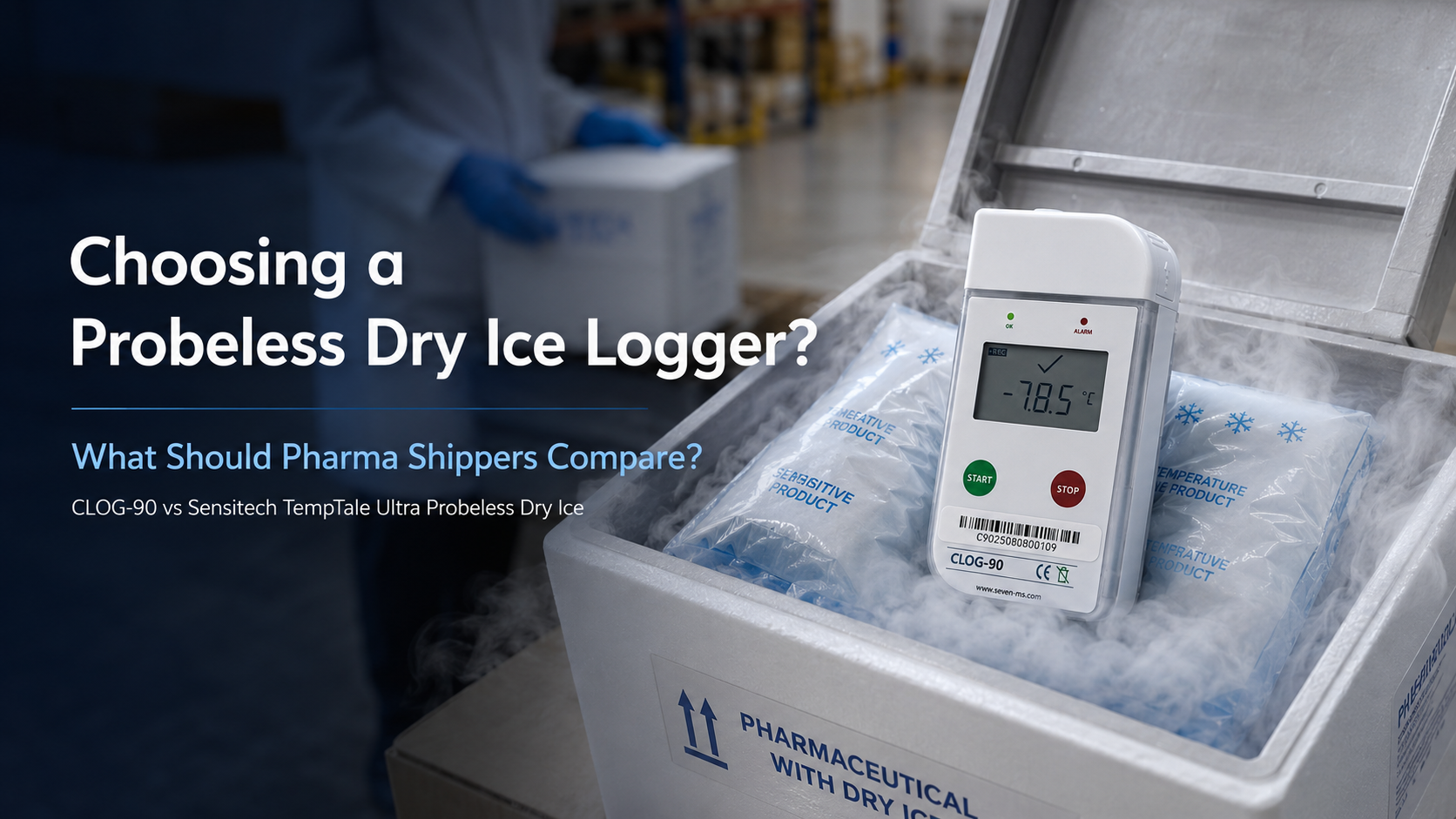
When a pharmaceutical shipment moves on dry ice, the question is not simply whether the logger can survive the cold. The real question is whether the device can give the quality team a complete, usable record after the shipment arrives.
That is why CLOG-90 and Sensitech TempTale Ultra Probeless Dry Ice belong in the same buying conversation. Both are designed around a probeless concept: the logger itself travels inside the ultra-low-temperature package, rather than leaving the electronics outside the box and routing a cable to an external sensor.
At first glance, the comparison looks simple. Both are USB loggers. Both are intended for dry ice. Both can be placed close to the product. But for pharma shippers, the differences that matter are usually found in the workflow around the device, not just in the headline temperature number.
Start with the shipment, not the brand
Before comparing two model numbers, define the shipment you are actually trying to protect. A clinical sample moving for 24 hours between two laboratories has a different risk profile from a biologic moving internationally for five days with handovers between a pack-out site, airline, customs broker and receiving warehouse.
For each lane, ask a few basic questions. How long can the shipment remain in dry ice? What temperature limits are tied to product stability? Does the receiving team need an immediate OK/alarm indication? Does QA need a PDF only, or a broader validated data workflow? Is the logger a one-way consumable, or part of a larger enterprise monitoring system?
Once those questions are clear, product comparison becomes much more useful.
1. Lower-temperature capability
CLOG-90 is specified by MESAVSS down to -95°C. Sensitech states that the TempTale Ultra Probeless Dry Ice unit can be placed directly into dry ice environments as low as -95°C. Sensitech's currently linked industrial datasheet also distinguishes between operating range and measurement range, so buyers should read the exact specification rather than relying on a single marketing number.
This matters because dry ice shipments are often discussed as “-78°C” or “-80°C” shipments, yet the actual temperature seen at the logger can fall below that. If your logger reaches the end of its measuring range, you may lose detail exactly where you need evidence most.
2. Probeless placement
The biggest practical advantage of a probeless logger is simplicity. There is no external probe to route through insulation, no cable position to manage, and no need to keep the logger body outside the cold zone.
CLOG-90 is designed so the complete unit can travel inside the package near the payload. Sensitech's probeless dry ice model follows the same basic architecture. That makes both relevant for one-way dry ice shipments where the shipper wants a direct record of conditions inside the package.
Placement still matters. A logger sitting against a block of dry ice may see a different thermal profile from one placed beside the product. The best device cannot compensate for a poorly defined monitoring point.
3. What the receiver can see immediately
A receiving team often needs to make a fast first decision before opening a full report. CLOG-90 provides an LCD for current temperature, alarm status and trip statistics such as minimum, maximum and average temperature. Sensitech also uses an LCD to show alarm status and trip information.
For operations, that immediate status can be more valuable than it sounds. It can help the receiving team decide whether the shipment can move directly to controlled storage or needs to be held for quality review.
4. Reports and data access
Both products are designed around USB data retrieval. CLOG-90 generates an encrypted PDF report when connected to a computer, without requiring a dedicated reader. Sensitech's unit can generate a secure PDF and encrypted data file and can also feed data into Sensitech software environments such as TempTale Manager Desktop or ColdStream.
This is where the buying decision may change. If your organization already uses Sensitech software across dozens of lanes, a logger is part of an established data ecosystem. If your workflow is primarily shipment-level and the requirement is a portable PDF record at destination, a simpler USB-centered process may be sufficient.
5. Alarm logic
Do not compare only the number of alarms. Compare how your stability rules are translated into the logger configuration.
Some products need a simple high/low threshold. Others require cumulative duration, multiple bands, or specific handling of short spikes. Sensitech documents up to six programmable alarms for its probeless dry ice model. CLOG-90 supports multiple alarm ranges. The right question for your quality team is whether the alarm logic matches the product's excursion decision rules.
6. Calibration and validation evidence
For pharmaceutical use, this is often the decisive point. Sensitech documents access to a three-point NIST-traceable calibration certificate and has a mature software and validation ecosystem around the TempTale family.
When evaluating CLOG-90, buyers should review the calibration documentation, accuracy specification, product qualification records and any airline or transport documents required for the intended lane. A lower-cost logger is not a meaningful alternative if the documentation cannot support your SOP and quality system.
The reverse is also true: not every shipment requires the same enterprise software stack. Match the level of validation and documentation to the actual risk and regulatory requirement.
7. Total deployment fit
A serious comparison should include more than unit price. Consider configuration effort, receiving workflow, training, return logistics, software licenses, data archiving, supplier lead time and the ability to support different shipment profiles.
For a global pharma company already standardized on Sensitech, keeping one ecosystem can reduce process variation. For a company qualifying a second source, running a pilot lane, or looking for a probeless one-way logger with direct PDF access, CLOG-90 may be worth evaluating.
That is a more useful way to think about an “alternative”: not as a claim that two products are identical, but as a question of whether both can solve the same monitoring problem within your quality requirements.
The practical takeaway
CLOG-90 and Sensitech TempTale Ultra Probeless Dry Ice address a similar core need: monitoring temperature from inside a dry ice shipment without an external probe.
The right choice depends on the wider workflow. Sensitech has clear strengths in established life-sciences data management and validation processes. CLOG-90 is positioned as a single-use, probeless USB logger for direct placement, local display and straightforward report retrieval.
If you are qualifying a dry ice logger, build the comparison around the shipment and the quality decision you need to make at destination. That will tell you far more than a specification sheet alone.
FAQ
Is CLOG-90 a direct replacement for Sensitech TempTale Ultra Probeless Dry Ice?
It should be evaluated as an alternative for a similar probeless dry ice use case, not assumed to be a drop-in replacement. Qualification should cover temperature range, accuracy, alarms, calibration evidence, reporting, SOP compatibility and any required airline documentation.
Why choose a probeless logger for dry ice?
A probeless design allows the complete logger to travel inside the ultra-low-temperature package, avoiding external probe cables and giving a direct record near the payload.
Does a -95°C lower limit matter if dry ice is around -78.5°C?
It can. Actual conditions inside dry ice packaging may go below -80°C, so additional low-temperature measuring range can help avoid a data blind spot.
What should pharma QA compare first?
Start with product stability limits and the quality workflow. Then compare measurement range, accuracy, alarm logic, calibration/validation evidence, report integrity and data handling.
Trademark Notice: Sensitech and TempTale are trademarks of their respective owners. MESAVSS is not affiliated with, endorsed by, or sponsored by Sensitech. Product information referenced in this article is based on publicly available manufacturer information and is provided for comparison purposes only.